Five UK Coastal Walks for Seabird Watching in Spring and Summer
From late April to mid-July, Britain's sea cliffs become the noisiest neighbourhoods in the country. Guillemots crowd onto ledges shoulder to shoulder, kittiwakes squabble over inches of rock, and puffins whirr in from the water with beaks full of sandeels. By August most of the auks have gone back to sea and the ledges empty. The five walks below are timed to make the most of a short season.
Dates matter more than anything else. Turn up in early March and you will see fulmars and little else; turn up in late July and the cliffs may be half-empty. Aim for the second half of May and June.
Weather matters as much as dates. Choose a dry day with light wind; strong onshore gusts make clifftop paths dangerous and keep birds sitting tight. Early morning is best for auks on the ledges, and the last hours of daylight for rafts of puffins and shearwaters on the water.
The RSPB reserve at Bempton is the easiest big seabird spectacle in England. A surfaced clifftop path links the visitor centre to a string of viewing platforms, so you can see the best of it in an hour or two without ever being far from a handrail.
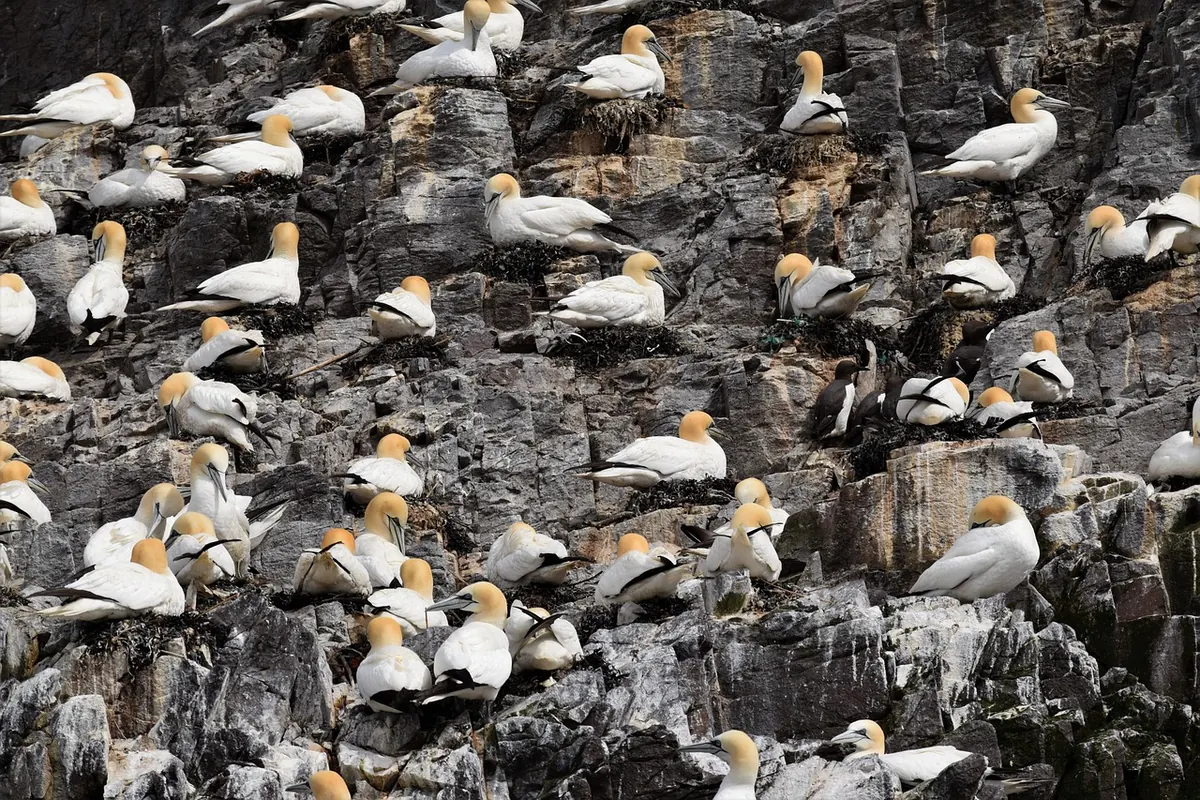
Bempton holds England's only mainland gannet colony, and in June the chalk cliffs below the path are white with them. Guillemots and razorbills pack the narrower ledges, kittiwakes nest on the stacks, and a few hundred pairs of puffins appear on the slopes and on the sea. Puffins are the tricky ones: small, dark and fast, usually flying low over the water.
Arrive early in midsummer, and stay behind the fence. The chalk overhangs, and the edge is not as solid as it looks.
South Stack sits on the western tip of Holy Island, where the cliffs drop into a fast-moving channel. Park at the reserve, walk out to Ellin's Tower and continue along the clifftop; the Anglesey Coast Path runs straight through, so you can extend the walk in either direction.
This is the place to compare guillemots and razorbills side by side, slim and brown against stocky and black, and the racket from the ledges is extraordinary. Fulmars glide past on stiff wings, choughs wheel over the heath and peregrines hunt along the ridge. Puffins appear in modest numbers, so treat them as a bonus.
A steep flight of steps drops to the lighthouse and the lower viewpoint. Worth it if your knees are willing, but on a windy day watch from the top instead; the updraught keeps birds at eye level anyway.
Troup Head is a proper walk rather than a stroll. Start from the car park at Cullykhan Bay, near Pennan, and follow the clifftop path east for around an hour to reach the RSPB reserve. The path is grassy, unfenced in places and muddy after rain, so wear boots.
The reward is a mainland gannetry, one of very few in Scotland, with birds nesting on the face in front of you rather than on an island offshore. In early summer gannets circle and plunge by the hundred while guillemots, razorbills, fulmars and kittiwakes fill the gaps, and porpoises often show offshore.
Livestock grazes parts of the route, so keep dogs on a lead and close gates. Where the path looks undercut, turn back rather than testing it.
Sumburgh Head, at the southern tip of Shetland, is the closest you will get to puffins without crossing water. From the car park below the lighthouse a short path loops around the headland, and puffins nest in burrows within a few metres of it. You can watch them land, preen and squabble with no hide and no telescope.
It suits children, photographers and anyone who finds long walks difficult; the circuit takes well under an hour at a dawdle. Guillemots, razorbills, fulmars, shags and kittiwakes nest nearby, and early summer is the best time to scan the sea for cetaceans.
Two cautions. The road up is narrow, with passing places, so allow extra time in summer. And the wind here can be fierce even when the rest of Shetland is calm.
This one comes in two parts. First, an easy clifftop walk: from the National Trust car park at Martin's Haven, follow the path out towards Wooltack Point, looking across Jack Sound to Skomer. In the evening, watch puffins and Manx shearwaters gathering in rafts as they wait to come ashore.
Second, the crossing. Boats run from Martin's Haven to Skomer from spring to autumn, weather permitting, and they fill up, so book ahead and accept that wind can cancel a sailing. On the island, waymarked paths pass puffin burrows, and in May the clifftops are blue with bluebells. Landing fees apply, and dogs are not allowed.
Stay on the paths. Burrows collapse easily underfoot, and the shearwaters, one of the largest colonies in the world, nest underground.
A few habits make these walks safer and better.
Go midweek if you can, arrive early, and allow more time than the route suggests. The best moments – a puffin landing two metres away, a gannet hitting the water like a thrown spear – rarely arrive on schedule.
Photo: ifinnsson / Pixabay
Previous Post
How to Make Your Garden a Bird-Friendly Habitat: A Practical Conservation Guide
Next Post
Bird Ringing and Citizen Science: How Your Sightings Help UK Conservation